Biography of Nicolaus Copernicus: the astronomer who changed the center of the universe
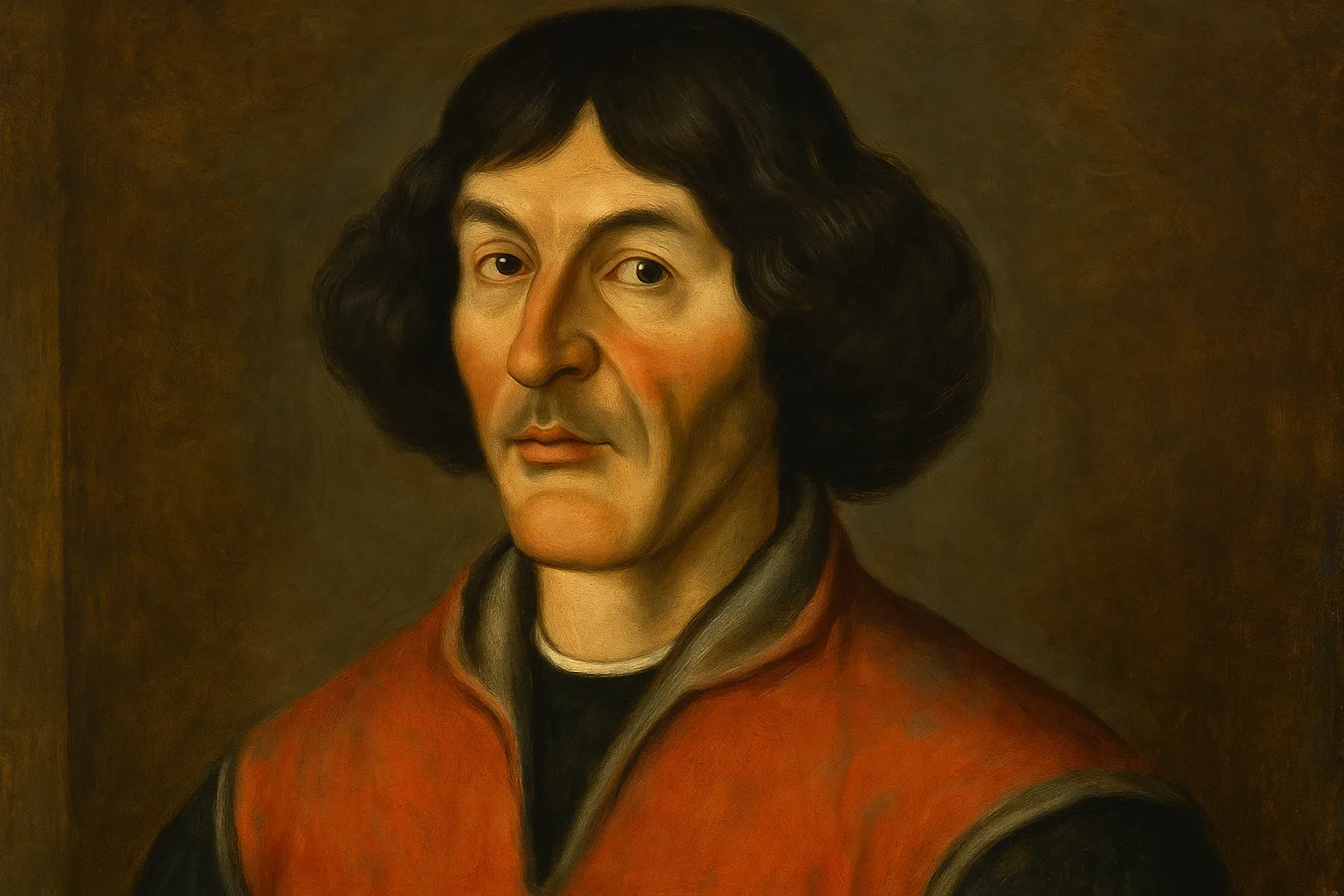
For centuries, humanity believed that Earth was the center of the universe and that the heavens revolved around it like a grand celestial carousel. This worldview, inherited from Aristotle and reinforced by Ptolemy, was more than just an astronomical theory—it shaped how people saw their place in the cosmos. Until one man, quietly and patiently, dared to look at the sky with new eyes. That man was Nicolaus Copernicus.
Copernicus was not a banner-waving revolutionary. He was a meticulous scholar, a cautious mathematician, and a church canon. But his life’s work, published only at the end of his days, displaced Earth from the center of the cosmos and laid the foundation for the modern scientific revolution.
Building a Free Mind
Nicolaus Copernicus was born on February 19, 1473, in Toruń, a commercial city in Royal Prussia (present-day Poland), into a well-off family of merchants. His father died when he was around ten, and his education was overseen by his uncle Lucas Watzenrode, the Bishop of Warmia.
Thanks to his uncle, Copernicus received an elite education. He studied at the University of Kraków, where he was first exposed to astronomical ideas. There, he became familiar with Ptolemy’s works and the complex mathematical models used to explain planetary motion. Even at that early stage, something didn’t quite fit with the geocentric model.
He later traveled to Italy to continue his studies. Between 1496 and 1503, he attended the universities of Bologna, Padua, and Ferrara, studying Canon Law, Medicine, and of course, Astronomy. It was during this time that the seed of his revolutionary idea began to take root.
A Universe in Conflict
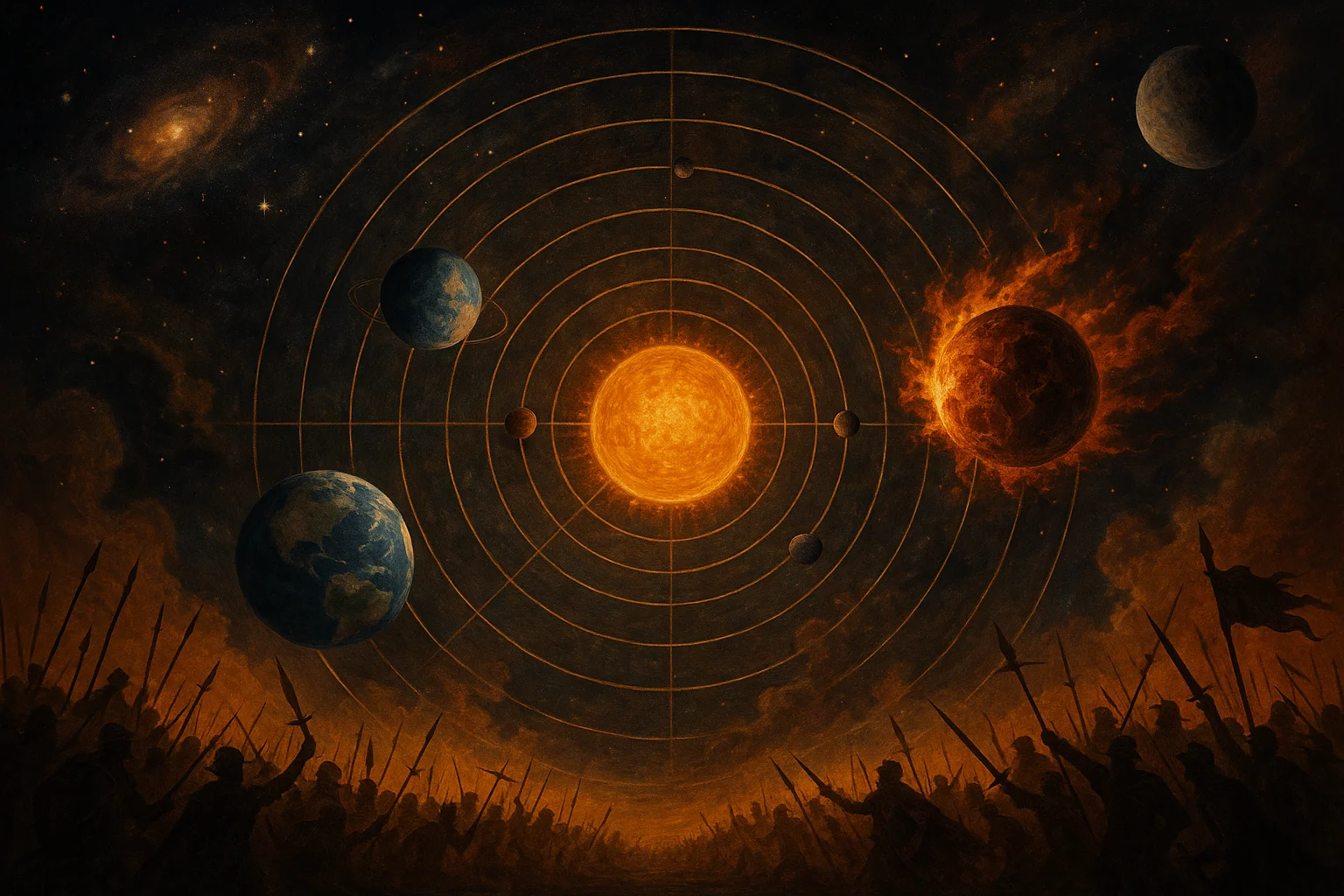
In Bologna, Copernicus collaborated with astronomer Domenico Maria Novara da Ferrara, and began observing the skies with increasing skepticism. The irregularities in planetary movements and the cumbersome corrections required by the Ptolemaic system appeared increasingly artificial to him.
The geocentric model required multiple “epicycles”—circles upon circles—to explain retrograde motion. While it worked for prediction, it lacked elegance and internal logic. Copernicus began considering an ancient, long-forgotten alternative: the heliocentric theory proposed by Aristarchus of Samos in the 3rd century BCE.
But Copernicus was not a Greek philosopher; he was a mathematician. He knew he needed solid evidence and a consistent system to be taken seriously. That’s why he kept his theory private for decades.
De revolutionibus orbium coelestium
For more than 30 years, Copernicus developed his heliocentric theory in secrecy. He observed, calculated, and refined his model from his residence in Frombork, where he served as a canon of the cathedral.
In 1543, with his health in decline, he finally allowed the publication of his major work: De revolutionibus orbium coelestium (“On the Revolutions of the Celestial Spheres”). His friend Georg Joachim Rheticus, a young mathematician and devoted admirer, persuaded him to make it public.
The book proposed what was then unthinkable:
- The Sun, not the Earth, is the center of the universe.
- The planets revolve in circular orbits around the Sun.
- Earth not only rotates on its axis but also orbits the Sun.
Although the model included some errors—like assuming perfectly circular orbits—the core idea was revolutionary. Earth was no longer the cosmic throne of humanity.
A Truth Slow to Awaken
The publication of De revolutionibus did not cause an immediate scandal. The reason is simple: few people fully understood it at first. The book was dense, mathematical, and highly technical. For most theologians and even many astronomers, it was a curiosity—not yet a threat.
Over time, however, the ideas began to inspire and provoke. Astronomers like Tycho Brahe criticized Copernicus, while Johannes Kepler defended and refined his model. And then came Galileo Galilei, who, telescope in hand, became the great validator of the Copernican system.
The Catholic Church, which initially tolerated the book, placed it on the Index of Forbidden Books in 1616 when heliocentrism became a direct challenge to Scripture. Ironically, Copernicus himself was a devout member of the clergy.
A Permanent Shift in Thought
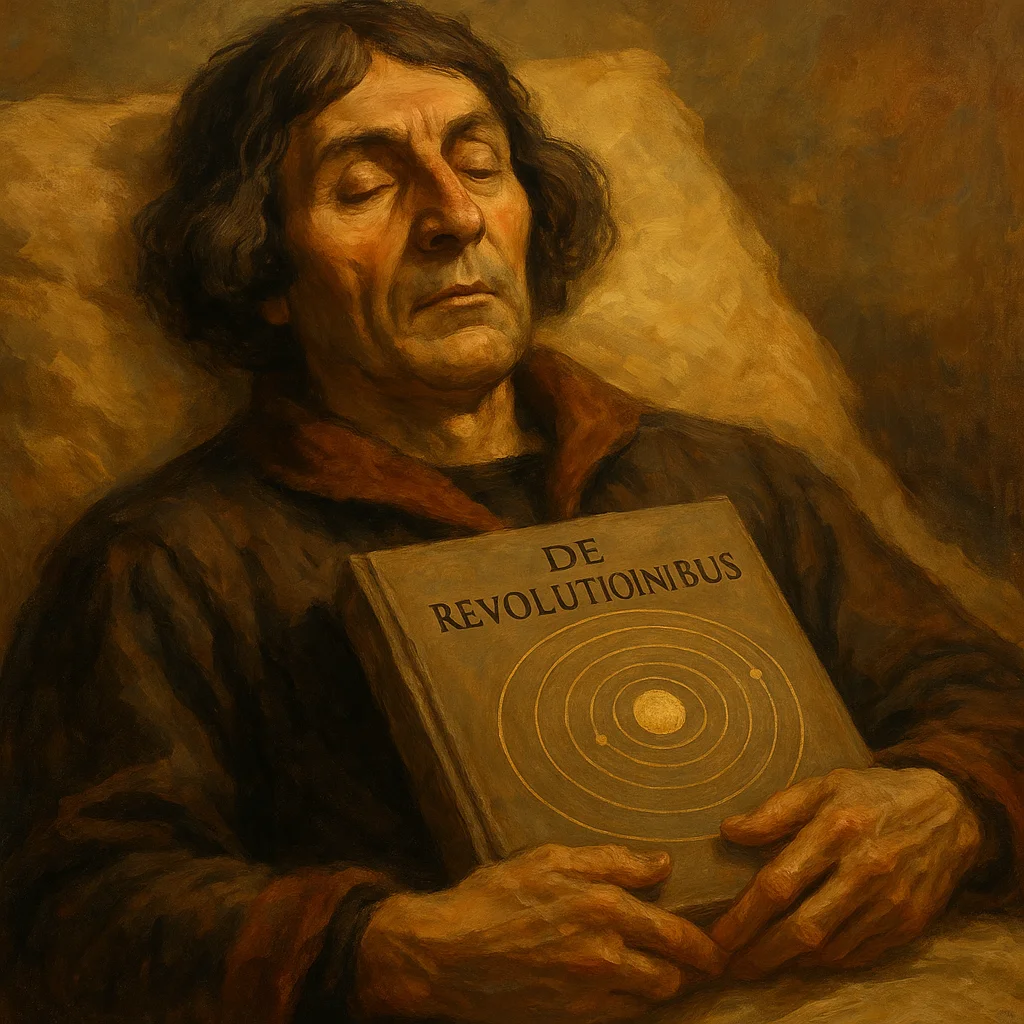
Nicolaus Copernicus died on May 24, 1543, shortly after receiving a printed copy of his book. Legend has it that he saw it on his deathbed, though he likely never grasped the full scope of its future impact.
His legacy is immense. Copernicus didn’t merely shift celestial mechanics—he altered humanity’s view of itself. His work marked the first step toward the Scientific Revolution, which transformed not only astronomy but also physics, biology, and philosophy.
Copernicus as a Symbol of Critical Thinking
Copernicus was not an agitator. He was a man of serene doubt, of careful observation and deep thought. His work reminds us that great revolutions do not always require noise, but rather rigor, patience, and intellectual honesty.
Today, his name is synonymous with one of the greatest turning points in the history of knowledge: the “Copernican Revolution,” a phrase we use not only in science but in any radical shift in perspective.
Quotes and Curiosities
- ✍️ While he left few famous quotes, he believed that “the pursuit of truth is the highest calling of the human mind.”
- 📍 His grave was rediscovered in 2005 and confirmed in 2008 through DNA testing and facial reconstruction.
- 🧪 The European Space Agency named one of its Earth observation missions “Copernicus” in his honor.
- 🌌 A prominent lunar crater, Copernicus, bears his name.
The Man Who Removed Earth to Center Reason
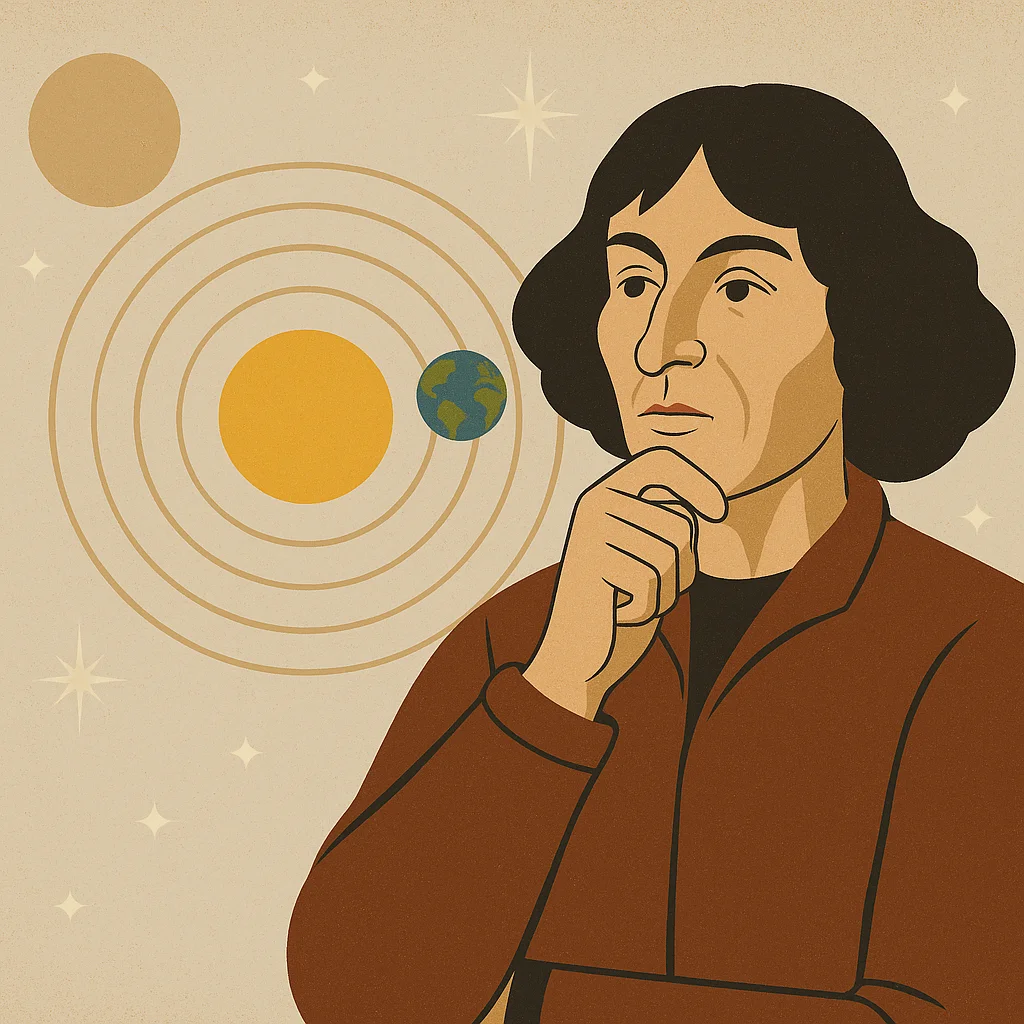
Nicolaus Copernicus changed the world without ever leaving his own. Through silent observation and tireless calculation, he revolutionized our vision of the cosmos. He taught us that knowledge does not impose—it convinces, and even the most deeply held truths can be reevaluated under the light of evidence.
He was not a warrior or a martyr, but a thinker. And that way of shaping history—without violence, with reason—may be his greatest legacy of all.